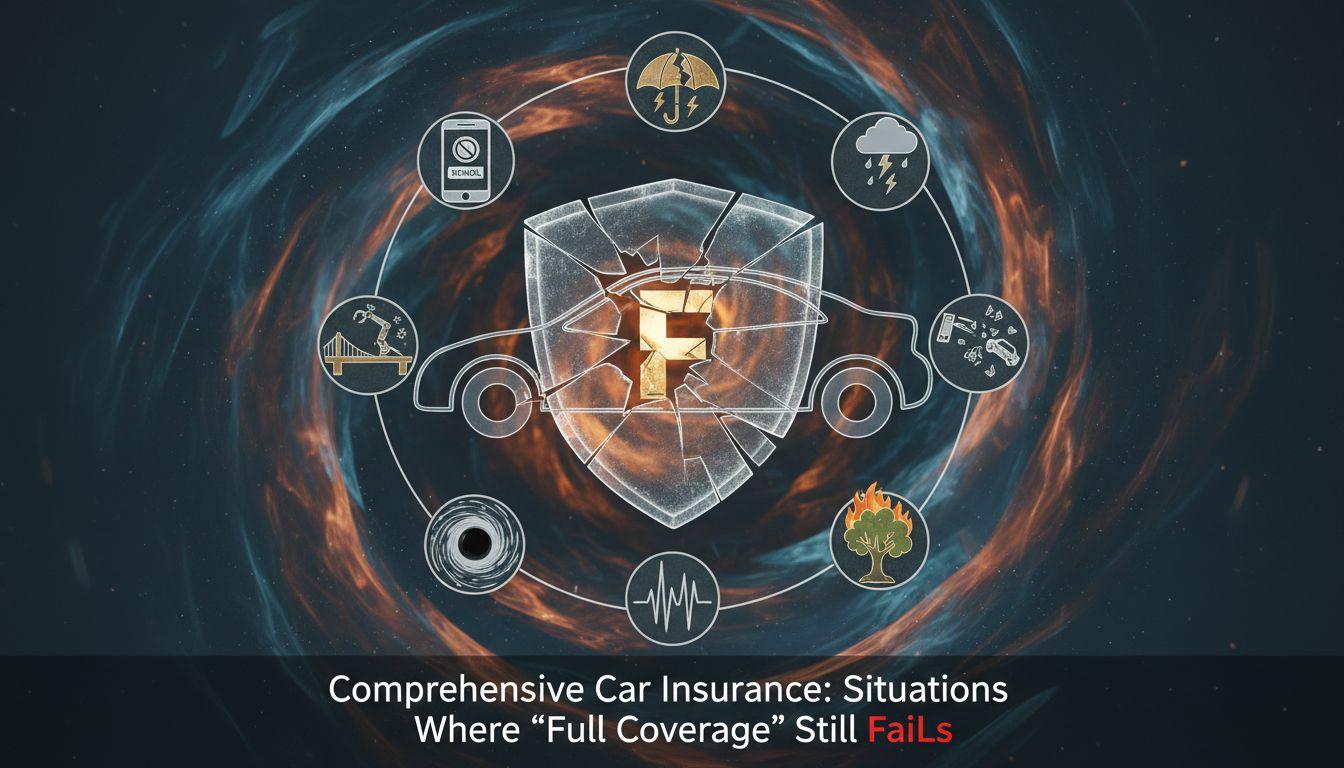
Complete car Insurance: Situations Where “Full Coverage” Still Fails
“Full coverage” is a marketing shortcut, not a financial guarantee
In everyday conversation, Comprehensive car Insurance is often treated as a synonym for safety.
Pay the higher premium, check every box, and you’re “covered.”
From a financial perspective, that assumption is where trouble starts.
Comprehensive coverage is one component in a stack of policies and deductibles, all interacting with depreciation,
loan balances, claim rules, and insurer incentives.
Understanding where “full coverage” fails is less about reading policy fine print and more about understanding
how money actually flows after a loss.
What actually happens after a loss most drivers don’t model
perspective: The Mechanic’s View
Let’s walk through the mechanics.Suppose your car is stolen or totaled by a falling tree.
Comprehensive coverage applies — but the payout is not “what you need,” or “what you owe,” or “what you paid.”
in many cases, insurers calculate:
- The vehicle’s actual cash value (ACV) at the time of loss
- Minus your comprehensive deductible
- Minus any adjustments for condition, mileage, or prior damage
If you’re financing or leasing, the insurer pays you or the lienholder up to that ACV.
If your loan balance exceeds the ACV — a common outcome in the early years of auto loans —
comprehensive insurance stops right there.
This is why lenders often push gap coverage. It exists as comprehensive coverage alone
frequently leaves a balance behind.
Consumer-focused breakdowns from sources like
Consumer Reports
and insurer explanations from
Progressive
align on this point: the math is predictable, even if the outcome surprises drivers.
Why smart, financially literate people still overestimate protection
Perspective: The Behavioral Lens
The misunderstanding isn’t about intelligence; it’s about framing.
“Full coverage” triggers a completion bias — the sense that once all boxes are checked,
risk has been neutralized.
Three common behavioral errors show up repeatedly:
- Asset anchoring: People anchor on what the car cost, not what it’s worth today.
- Loan blindness: Monthly payment focus crowds out awareness of outstanding principal.
- Premium justification: Higher premiums feel like they should buy certainty.
Insurers don’t price policies to eliminate your downside — they price them to pool risk efficiently.
Once you internalize that, the mismatch between expectation and reality becomes easier to anticipate.
Failure modes no one mentions until after the claim
Perspective: The Risk archaeologist
The most expensive failures aren’t the obvious exclusions. They’re the edge cases that only surface after a loss.
Rapid depreciation meets long loan terms
Extended auto loans lower monthly payments but slow equity build-up.
Comprehensive insurance doesn’t care how long your loan runs — only what the car is worth today.
Deductibles as liquidity stressors
A $1,000 deductible is manageable on paper, but in practice it’s an immediate cash demand.
For households without ample short-term liquidity, the deductible itself can create financial strain.
Coverage gaps for non-standard losses
Flooding, civil disturbances, or animal damage are frequently enough covered — but only if classified correctly.
Claim classification disputes delay payouts and sometimes reduce them.
Guidance from the
National Association of Insurance Commissioners
highlights how classification drives outcomes.
What you gain — and give up — versus other protection strategies
Perspective: The Comparative Analysis
Comprehensive coverage is not “better” or “worse” in isolation. It’s one risk-transfer tool among several.
| Approach | What It Protects Well | Where It Falls Short |
|---|---|---|
| Comprehensive only | Non-collision physical damage | Negative equity, deductibles |
| Comprehensive + Gap | Loan balance mismatch | Higher total cost |
| Self-insuring older vehicles | Premium savings over time | Large, unpredictable losses |
For older, fully paid vehicles, dropping comprehensive can be rational.
For newer, highly leveraged purchases, comprehensive without gap coverage often creates a false sense of security.
Why insurers are cozy with your misunderstanding
Perspective: The stakeholder Perspective
Insurers don’t benefit from confusion, but they do benefit from standardization.
ACV-based payouts are predictable, defensible, and scalable.
From an issuer’s risk strategy:
- Depreciation risk stays with the borrower
- Loan structure is outside the insurer’s concern
- Deductibles reduce claim frequency and severity
This incentive alignment explains why comprehensive coverage pairs so neatly with long-term auto financing —
and why the gaps remain unless the buyer actively closes them.
A practical framework for deciding what to carry — and what to drop
Perspective: The Decision Architect
Instead of asking,“Do I have full coverage?” ask:
- What is my car worth today?
- What do I still owe?
- Could I absorb the deductible tommorow without stress?
- Would a total loss change my broader financial plan?
If the answers reveal asymmetry — high downside,low liquidity,slow equity —
comprehensive alone is likely insufficient.
Resources that walk through these decisions, such as
NerdWallet’s insurance guides
or insurer tools from
State Farm,
are useful starting points — but the final judgment is situational, not universal.




Have any thoughts?
Share your reaction or leave a quick response — we’d love to hear what you think!
-
 0
0
-
 0
0
-
 0
0
-
 0
0
-
 0
0
-
 0
0