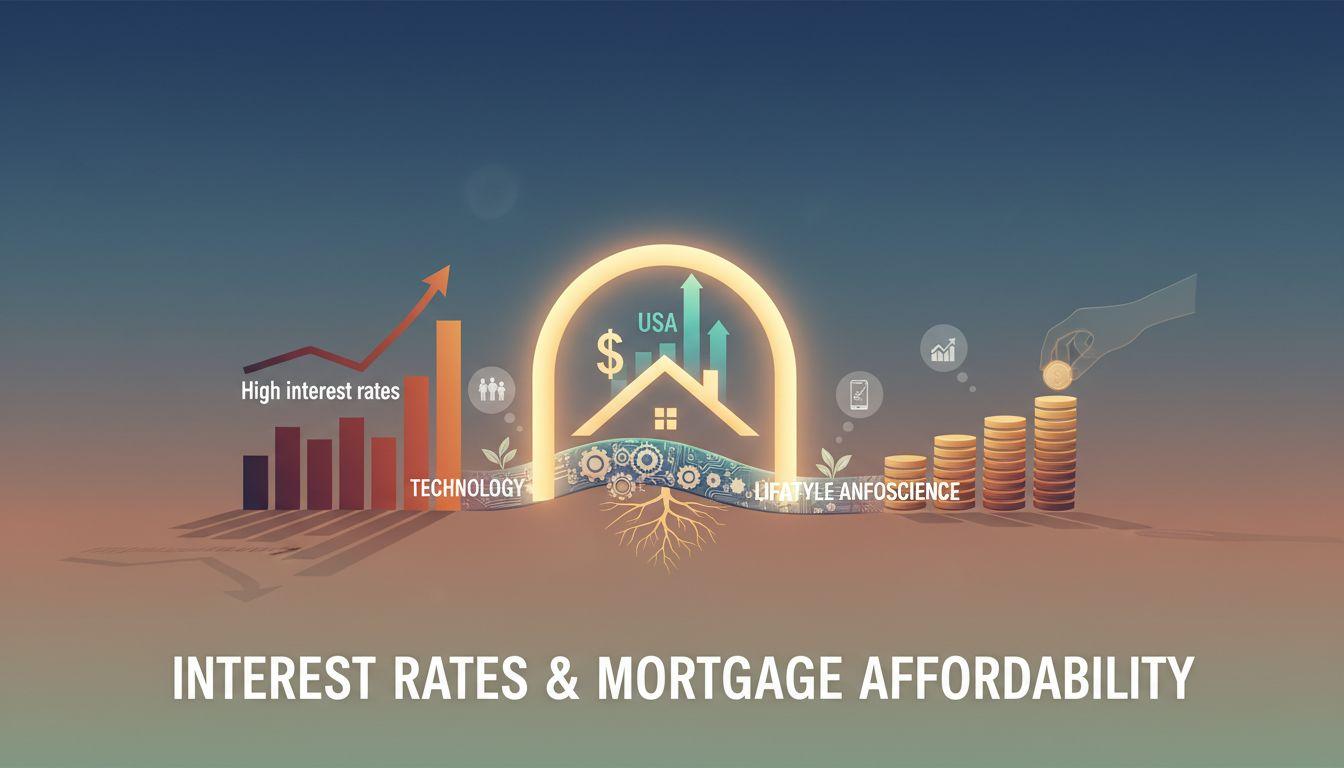
When “waiting for lower rates” quietly raises your mortgage risk
Most borrowers approaching today’s market carry a familiar tension: rates feel high relative to recent memory, yet home prices and rents haven’t meaningfully reset. That creates a subtle trap. Focusing only on interest rates today in USA and mortgage affordability can push borrowers into delaying decisions that actually increase long‑term financing risk—through lost equity, tighter underwriting, or product mismatches.
The strategic question is no longer “Are rates good or bad?” it’s whether current rate mechanics, lender behavior, and your balance sheet position create a decision window—or a reason to step back.
How underwriters are really stress‑testing affordability right now
From an underwriter’s seat, the headline rate matters less than payment durability. Most U.S. lenders still qualify borrowers using forward‑looking affordability buffers: higher assumed payments, conservative treatment of variable income, and tighter views on residual cash flow.
This matters because manny borrowers misread a pre‑approval as a stable entitlement. In practice, approvals are fragile when rates are volatile. A small rate move or change in debt profile can shift a file from “agreeable” to “borderline” without warning.
Borrowers should pause if they are qualifying only at the top edge of debt‑to‑income comfort. Even if guidelines allow it, lenders tend to price and process these files less favorably—frequently enough through higher points, slower turn times, or reduced product choice.
For context on how lenders frame affordability expectations, the Consumer Financial Protection Bureau’s overview of
mortgage qualification standards
reflects the practical emphasis on sustainable payments rather than nominal rates.
the behavioral mistake: anchoring to last decade’s rates
Borrower psychology is quietly shaping bad decisions. Many homeowners remain anchored to sub‑4% mortgage rates as “normal,” even though those conditions were historically anomalous. This anchor causes two errors: overpaying for temporary buydowns, or refusing structurally sound loans while waiting for a rate surroundings that may not return in the same form.
The decision implication is not to ignore rate levels, but to stop treating them as the primary variable. A mortgage is a multi‑year risk instrument. Payment stability, exit flexibility, and equity growth often outweigh the first‑year rate.
This creates a decision fork: optimize for the lowest initial rate and except rigidity, or accept a higher starting rate paired with structural flexibility that protects future choices.
Fixed, adjustable, or temporary buydown: the product trade‑off most borrowers miss
Product selection today is less about guessing rate direction and more about matching risk exposure to your holding period. Thirty‑year fixed loans offer payment certainty but lock in today’s pricing. adjustable‑rate mortgages (ARMs) and temporary buydowns reallocate that risk across time.
Lenders are currently incentivized to push products that manage their own duration risk—often ARMs or loans with upfront points. That doesn’t make them bad products, but it dose mean borrowers must be explicit about their exit plan.
Borrowers should hesitate before choosing a product whose success depends entirely on refinancing. Refinancing is a privilege, not a guarantee, as outlined in long‑term rate trend discussions from
Freddie Mac’s Primary Mortgage Market Survey.
If the loan only works if rates fall quickly, the risk is being underpriced in your decision.
Equity isn’t just upside—it’s your future rate negotiator
Viewed across time,equity is the most underappreciated hedge in a higher‑rate environment.Lenders price aggressively for low loan‑to‑value borrowers, not out of generosity, but as equity reduces loss severity and improves capital efficiency.
This shifts the affordability conversation. A slightly higher rate on a purchase that accelerates equity accumulation can outperform a lower‑rate loan that stretches leverage. Equity improves refinance options, reduces mortgage insurance drag, and opens alternative capital strategies later.
At this point, the trade‑off becomes clear: maximize short‑term payment relief, or preserve long‑term financing leverage. For borrowers early in ownership, the latter often dominates.
Why lenders’ incentives matter more than their advertised rates
Lender behavior today is shaped by margin pressure and balance‑sheet management. When rates move quickly, lenders adjust pricing through points, credits, and underwriting overlays rather than headline rates.
This explains why two borrowers with similar profiles can see very different offers.One might potentially be more attractive to a lender’s capital model—even at the same rate—due to loan size, equity, or product type.
Decision implication: borrowers should compare offers on total economic cost and flexibility, not just APR. The rate is only one expression of lender appetite.
coverage of how lenders adapt to rate cycles, such as recent housing finance reporting
from The wall Street Journal,
provides useful context for why pricing dispersion widens in uncertain markets.
Scenario planning without pretending to predict rates
Effective mortgage planning doesn’t require a rate forecast. It requires scenario resilience. Ask how the loan performs if rates stay broadly similar, drift modestly lower, or remain volatile.
A resilient mortgage keeps acceptable payments under all three scenarios. A fragile one only works in a single outcome. Borrowers should avoid structures where affordability collapses without a refinance prospect.
This is where many affordability calculators mislead. They model payment capacity, not decision durability. Before stretching loan size, review
our mortgage affordability checklist
to pressure‑test your assumptions.
What past rate cycles reveal about refinancing myths
Looking backward, refinancing waves tend to be brief and uneven. Borrowers who assume they can “always refi later” underestimate operational risk: appraisal gaps, income changes, credit events, or tighter guidelines.
Historical analysis from the Federal Reserve shows that refinancing access narrows quickly when volatility rises, even if rates are attractive
(Federal Reserve economic notes).
The decision implication is straightforward: if a mortgage only makes sense after a successful refinance, it may not be a sound first mortgage.
Designing a mortgage decision that survives uncertainty
Good mortgage decisions today are engineered, not optimized. They balance payment comfort, equity trajectory, and exit optionality under imperfect information.
Borrowers should proceed when the loan works even if rates merely stagnate—and step back when affordability depends on favorable market timing. that distinction matters more than whether rates feel “high” or “low.”
If you’re evaluating whether current conditions justify action, delay, or restructuring, review
our refinancing strategy guide
to map choices against realistic future paths.
Mortgage products, lender criteria, and interest rates change frequently.
Your financial situation, credit profile, and property are unique.
Always seek advice from a qualified mortgage adviser before committing to any loan.




Have any thoughts?
Share your reaction or leave a quick response — we’d love to hear what you think!
-
 0
0
-
 0
0
-
 0
0
-
 0
0
-
 0
0
-
 0
0