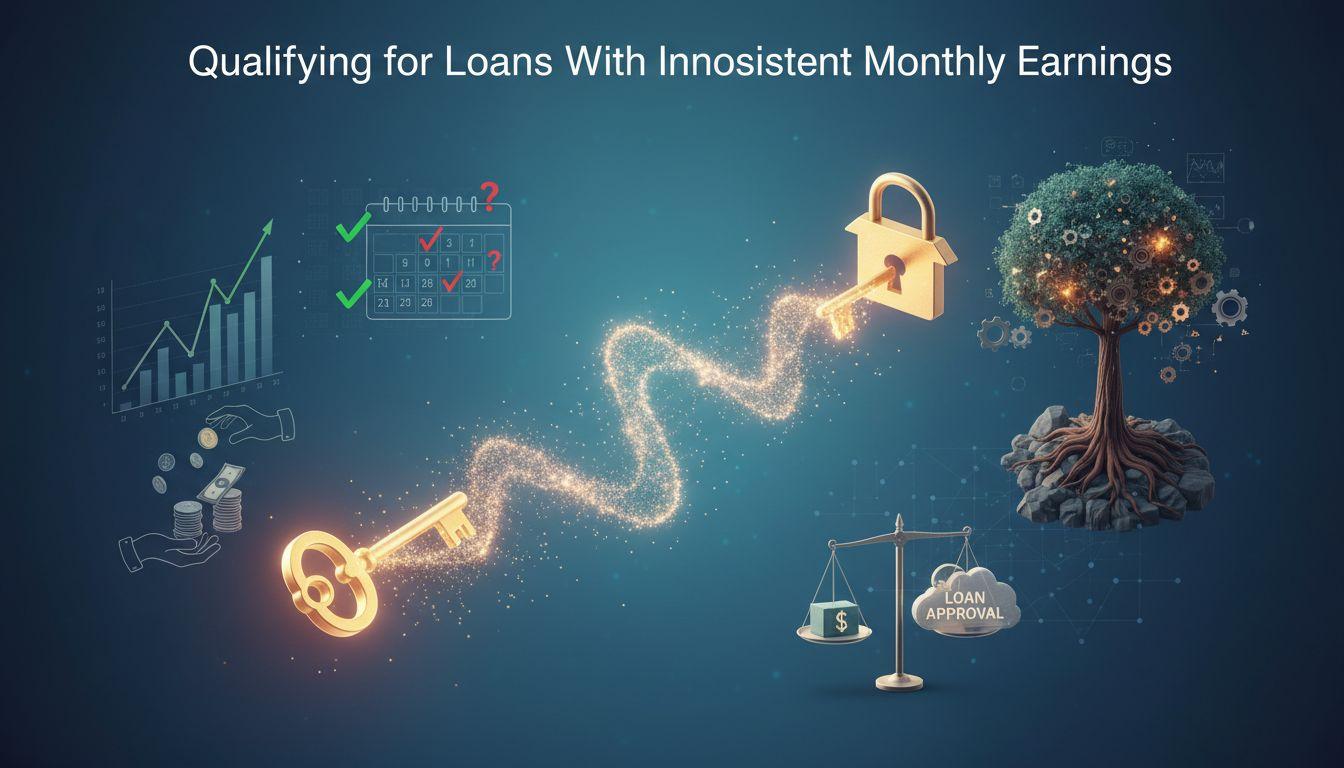
Qualifying for Loans When Your Earnings don’t Follow a Straight Line
Why Customary Income Verification Often Misleads for Variable Earners
Most loan qualification frameworks operate under the assumption that income is relatively predictable and stable — a steady paycheck every two weeks, often with modest, documented raises or bonuses. But what if your earnings are anything but stable? Freelancers, gig economy workers, commission salespeople, seasonal entrepreneurs: their monthly income can spike or plummet without warning.
In these cases, lenders tend to dig into the past 12–24 months of income history, averaging it to form a baseline. the illusion here is twofold:
- That historic averages alone capture future capacity to repay;
- That variability can be smoothed into a ”stable” figure lenders feel comfortable with.
Why is this misleading? Because averaging masks volatility. Just as you earned $120k last year doesn’t meen you have $10k every month — some months may have been $20k, others nearly zero.
In practise, this creates a mismatch between your actual cash flow risk and what lenders perceive — leading to either needless denials or approvals based on an overly optimistic view of affordability.
Why We Frequently enough Underestimate Behavioral Biases When Applying
Here’s a common human error: applying with a single recent month’s income as it looks best, or conversely, discounting seasonal highs as ’exceptions’ and reporting lower overall averages. Borrowers frequently let frustration or hopes push them into presenting income in the light they wish lenders would see, rather than what truthfully reflects capacity.
This is compounded by the “anchoring” effect—the loan officer or underwriter may anchor on a single, documented paystub instead of a broader income pattern because it’s the easiest verification path. Borrowers who don’t appreciate this may inadvertently weaken their request by presenting confusing or incomplete income data.
Moreover, there is a psychological tendency to downplay uncertainty — variable earners often assume “my next client/project will cover it” without concrete contracts or evidence. This optimism bias contrasts with lender risk aversion, creating tension during underwriting.
Weighing Alternatives: Average Income vs. Look-Back Periods vs. Asset-Based Qualification
So what options exist for qualifying when income is inconsistent?
| Method | What It Captures | Pros | Cons |
|---|---|---|---|
| Annual or Monthly Income Averaging | Historical earnings smoothed over 12–24 months | Easy to process; aligns with tax returns; widely accepted | Hides volatility; may under- or overstate true regular earnings |
| Recent 3–6 Month Income Snapshot | Focus on latest earnings trend | Reflects current state; useful if income improving or stable | Volatility can appear exaggerated; seasonal industries disadvantaged |
| Asset-Based Qualification | Net worth and liquid assets as backup for repayment capacity | Bypasses income volatility; good for borrowers with strong savings or investments | Often requires large asset buffers; doesn’t prove cash flow sustainability |
Choosing one method over another involves trade-offs. While averaging smooths volatility, it may result in a loan that’s technically affordable on paper but risky in reality. Conversely, leaning heavily on most recent income may disqualify solid borrowers due to unlucky timing.
How Time Shapes Borrower and Lender outcomes in Loans With Variable Income
Consider this: a mortgage approved today based on a two-year average income — what happens six months into the loan if earnings fall sharply? Or if you get meaningful new clients boosting cash flow?
From the borrower’s perspective, an overestimated income leads to monthly payments that stretch budgets thin during lean periods, forcing credit card reliance or dipping into emergency savings. Over the long haul,this can hurt credit scores,increase stress,and may precipitate default.
Lenders face their own dilemma. For them,default risk often spikes in months when income drops below the estimated average. their pricing models and risk buffers (interest rates, down payments) aim to compensate for this, but unpredictability can still bleed into higher loss rates, prompting more conservative underwriting standards over time.
Conversely, conservative income estimates may save lenders but can throttle borrower access to opportunities like homeownership or business expansion — outcomes that generate positive financial momentum in the long run.
Practical Paths When Your income Jumps Around: What to Disclose and How
If you find yourself on the lender’s desk with patchy earnings, how should you approach the process?
- Be transparent — but contextualize. Rather of just submitting raw income numbers, prepare explanations tied to business cycles, seasonal demand, or growth phases. Back these with contracts, invoices, or evidence of pipeline.
- Leverage multiple income documents. Tax returns, bank statements, 1099s, payment processor reports, and profit/loss statements paint a fuller picture.
- Know which lender products better serve inconsistent incomes. Such as, some mortgage programs or personal loans explicitly accommodate self-employed or commission-heavy profiles using option qualification criteria. Industrial and regional lenders sometimes offer more flexible evaluation schemes than national banks.
- Consider asset buffers as financial security signaling. Even moderate savings or investments show you have fallback liquidity covering income dips, which lenders view favorably.
- Explore credit cards or lines of credit strategically. While revolving credit can be costly if used unwisely, properly managed credit lines augment cash flow versatility and build credit history, smoothing loan qualification downstream.
- be cautious of overBorrowing against optimistic income. High monthly payments are a trap when income fluctuates. Keep debt-to-income ratios conservative—even if underwriters calculate higher allowable limits.
understanding that income inconsistency is a real risk, lenders tend to see a “quality” variable earner as someone who doesn’t just show high earnings, but who exhibits financial discipline and forward planning.
Who Really Benefits from Income Averaging? Inside the Banker’s Head
Why do lenders persist with income averaging over alternatives? It boils down to balancing underwriting efficiency and risk control.
Lenders earn revenue by extending credit, but defaults are their costliest outcome.They want methods that are repeatable and reduce subjective judgment. income averaging—anchored on tax returns and documented earnings—is an objective filter minimizing approval bias and underwriting variation.
At the same time, income averaging protects lenders by embedding a smoothing buffer against short-term spikes, which might otherwise inflate borrower capacity artificially. This approach inherently favors borrowers whose incomes, while inconsistent month-to-month, show an upward or stable average trend.
Yet, for borrowers heavily reliant on one-off contracts or volatile markets, this strategy risks shutting the door prematurely.
Avoiding Trapdoors: Hidden Risks in Putting Variable Income on Your Loan Application
Beyond straightforward variability, many pitfalls lurk in variable income loan applications:
- Inflated projections: Borrowers counting on expected business growth without signed contracts or consistent history risk overcommitting.
- Credit card dependence: Using credit cards to smooth monthly shortfalls increases revolving debt and can trigger higher debt-to-income ratios during underwriting.
- Seasonality neglect: Seasonal workers sometimes misrepresent “peak” months as recurring income, masking low-income quarters that strain affordability.
- Documentation inconsistency: Missing or mismatched documents cause lenders to downgrade the usable income calculation.
- Underestimating interest rate impact: Small differences in interest rates on loans can compound dramatically over time, especially if income dips force refinancing or defaults.
Recognizing these hidden risks allows borrowers to strategize better and approach lenders with realistic, substantiated, and conservative income profiles.
Building a Framework for Decision: When to Seek Loans and What to Expect
Here is a distilled decision framework to guide variable earners:
- Assess your income pattern: Are dips predictable, seasonal, or truly random? can you project future cash flows with reasonable certainty?
- Gather comprehensive financial evidence: Tax returns, bank statements, contracts, savings, and assets.
- Identify loan types suited for your profile: some lenders and products explicitly cater to freelancers or variable-income borrowers; prioritize these.
- Calculate conservative monthly payment capacity: Use the lowest recent monthly income or a weighted average, not the peak month.
- Prepare to supplement income with assets or co-signers if income volatility is severe.
- Maintain a buffer of emergency funds and keep revolving debts low before applying.
No silver bullet exists, but adopting a transparent, realistic, and evidence-driven approach helps align borrower capacity with lender risk appetite, smoothing approvals and reducing financial stress down the road.
For deeper borrowing and investment strategies tuned to income variability, consider exploring business credit options or dedicated banking products designed for variable-income professionals. Industry finance sites like CFPB or NerdWallet offer curated guides tailored to self-employed financing.




Have any thoughts?
Share your reaction or leave a quick response — we’d love to hear what you think!
-
 3
3
-
 0
0
-
 0
0
-
 0
0
-
 0
0
-
 0
0